This is the most expensive decision you will make early in a software project, and most businesses get it wrong in one of two directions. Some build a mobile app when a simple website would have brought in more customers for a tenth of the cost. Others patch together spreadsheets and WhatsApp for years when a modest web app would have saved their team hours every week.
The three options solve genuinely different problems. Here is how to tell them apart, and how to work out which one your business actually needs right now.
The short version
| Website | Web app | Mobile app | |
|---|---|---|---|
| Main job | Inform and convert | Let users do things | Engage and use device features |
| Runs in | Browser | Browser (with login) | Installed on a phone |
| Typical cost | ₹20,000 – ₹1,50,000 | ₹2,00,000 – ₹15,00,000 | ₹3,00,000 – ₹20,00,000 |
| Typical timeline | 1–5 weeks | 6 weeks – 6 months | 2–6 months |
| Needs an install | No | No | Yes (app store) |
| Found on Google | Yes, strongly | Partly (public pages) | No (app store search instead) |
| Best when | You need to be found and trusted | You have a workflow to digitise | You need notifications, camera, GPS, offline |
Website: your storefront on the internet
A website's job is to be found, understood, and trusted — then to prompt an enquiry. It presents information: who you are, what you offer, proof you are credible, and how to reach you.
Choose a website when you want to:
- Show up on Google when someone searches for what you do
- Present services, prices, menus, portfolios, or credentials
- Collect enquiries through forms, WhatsApp, or click-to-call
- Build trust before a customer walks in or picks up the phone
What it will not do: handle logins, manage bookings and inventory, or run custom business logic. The moment you need users to do something beyond sending a message, you have crossed into web app territory.
For most small businesses, this is the right first investment — and often the only one they need. A restaurant, clinic, consultant, or local service business will usually get more return from a fast, well-optimised website than from anything else.
Web app: software that runs in the browser
A web app is real software delivered through a browser. Users log in and do things: book appointments, place orders, manage records, view dashboards, run reports. There is nothing to install, it works on any device with a browser, and you can ship updates instantly to everyone.
Choose a web app when you need:
- User accounts with different permissions (customer, staff, admin)
- Custom workflows that match how your business actually operates
- A single source of truth to replace scattered spreadsheets and chat threads
- Automation — reminders, invoices, status updates, reports
- A product you can charge for, such as a SaaS subscription
The clearest signal you need one: your team spends hours each week on manual, repetitive coordination, or you are managing something important in a spreadsheet that several people edit.
A common and sensible pattern is a marketing website plus a web app behind a login — public pages that rank on Google, and the actual tool for customers and staff.
Mobile app: in your customer's pocket
A mobile app is installed on a phone. It earns its cost when you need what only a phone can offer.
Choose a mobile app when you genuinely need:
- Push notifications to bring users back regularly
- Camera, GPS, or sensors — scanning, photo capture, live tracking
- Offline use — field staff in areas with poor connectivity
- Daily or weekly engagement from a loyal, repeat user base
- A polished, app-store presence as part of your product strategy
Be honest about this one. Apps are the most expensive option, and getting people to install and keep an app is genuinely hard. If your customers will interact with you a few times a year, a website almost always serves you better. Build the app when you have engaged users who will use it often — not to look modern.
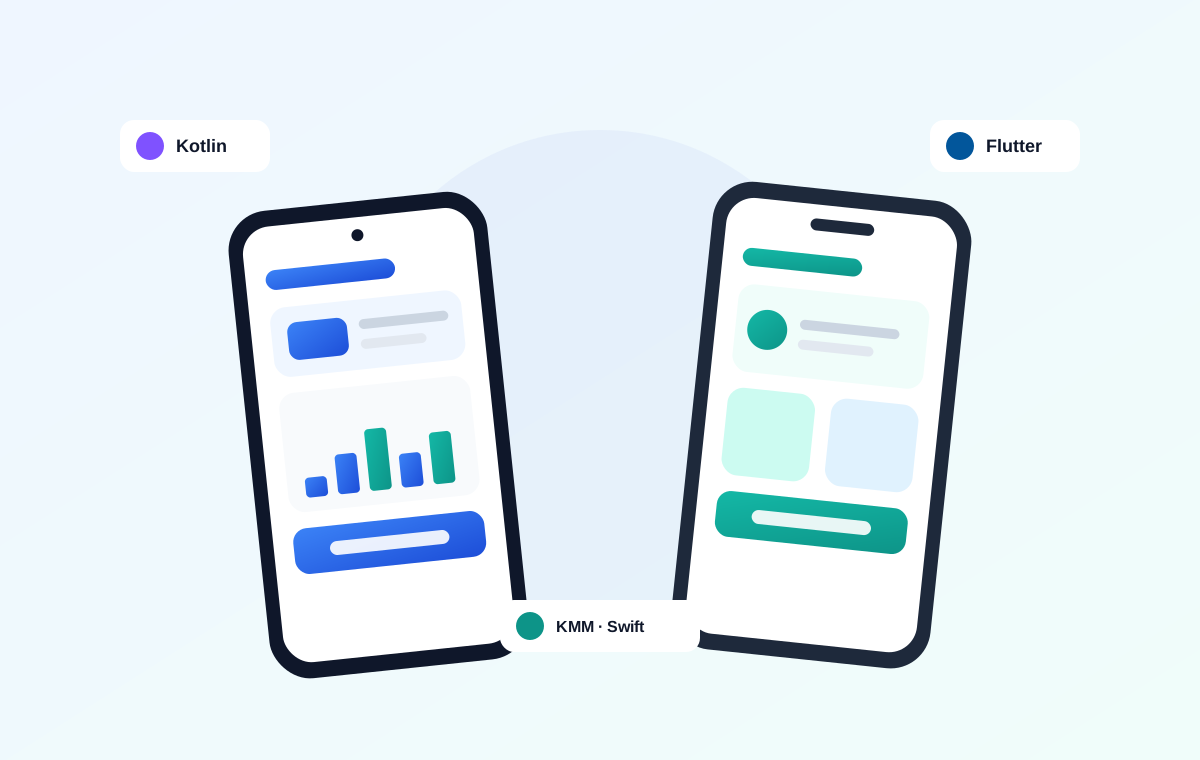
If you do need an app, the technology choice affects cost significantly. Cross-platform tools like Flutter and Kotlin Multiplatform build for Android and iOS from largely one codebase, often reducing cost substantially versus two native apps. We cover the trade-offs in native vs Flutter vs Kotlin Multiplatform.
A decision framework
Work through these in order. The first "yes" usually points to your answer.
- Do customers need to find you on Google? If you have no online presence at all, start with a website. Nothing else matters if nobody can find you.
- Do users need to log in and perform actions? If yes, you need a web app — at minimum alongside your site.
- Do you need push notifications, camera, GPS, or offline access? If yes, and only if yes, you need a mobile app.
- Will people use it at least weekly? If not, a mobile-friendly web app will serve you better than an app nobody opens.
- What is your budget and timeline? If tight, launch a website or a lean web app now and expand once it is earning.
The mistakes that cost the most
Building a mobile app first. The most common and most expensive mistake. Founders build for both app stores before validating demand, then discover installs are the hard part. A mobile-friendly web app tests the same idea for far less.
Choosing a website when you needed a web app. The opposite error. Businesses spend years on manual coordination because "we already have a website" — while a modest internal tool would have paid for itself in months.
Building everything at once. Scope grows, the launch slips, and you learn nothing from real users. Ship the core, learn, then extend.
Ignoring mobile. Most Indian web traffic is mobile. A desktop-first site loses the majority of its visitors regardless of which category you chose.
Not planning for growth. Ask whether today's build can be extended. A well-architected website can gain a booking system later; a rigid template cannot.
A realistic path for most businesses
You do not have to choose one forever. The sequence that works for most companies:
- Start with a website. Get found, look credible, collect enquiries. Weeks, not months.
- Add a web app when a workflow hurts. Bookings, orders, dashboards — build it when the manual pain is real and measurable.
- Build a mobile app once you have engaged users. By then you will know exactly what they need, and the app will have people waiting for it.
Each step funds the next, and each decision is made with real evidence instead of guesswork.
Still not sure?
Describe what you want customers or staff to be able to do, and the right category usually becomes obvious. If it is "find us and get in touch", that is a website. If it is "log in and manage something", that is a web app. If it is "get notified, scan, track, or work offline", that is a mobile app.
Tell us about your idea and we will recommend the most cost-effective path — including telling you if you need less than you think. You can also compare our services or read about what a website should cost.
Frequently asked questions
What is the difference between a website and a web app?+
A website mainly presents information — who you are, what you offer, how to contact you. A web app lets users log in and do things, such as booking appointments, placing orders, or viewing dashboards. If you need custom functionality behind a login, you need a web app.
Do I need a mobile app for my business?+
Only if you genuinely need push notifications, camera or GPS access, offline use, or frequent repeat engagement. If customers interact with you a few times a year, a fast mobile-friendly website will usually serve you far better and cost a fraction as much.
Can a web app work on mobile phones?+
Yes. A well-built web app is fully responsive and works in any phone browser with nothing to install. For many businesses this is a better first step than a mobile app, because you reach users instantly and can update it for everyone at once.
Which is cheapest to build?+
A website is the least expensive, typically ₹20,000–₹1,50,000. Web apps generally start around ₹2,00,000, and mobile apps are usually the most expensive because you are building for two platforms and going through app store review.
Should I build a website or an app first?+
Almost always the website. It gets you found on Google, establishes credibility, and generates enquiries quickly and cheaply. Add a web app when a manual workflow becomes painful, and build a mobile app once you have engaged, repeat users.
Have a project in mind?
Tell us what you need and we'll send a clear, fixed-price quote — usually within one business day.