
Ask business owners in the US, UK, or Europe about offshore development and you will hear two kinds of story: the one where a company got an excellent product for a fraction of local cost, and the one where months were lost and the code had to be thrown away.
The uncomfortable truth is that both are common, and the difference between them is rarely the developers' technical ability. It is almost always how the engagement was set up and run.
This is a practical playbook, written from the offshore side of that relationship, covering what actually determines which story you end up with.
Why offshore projects fail
In our experience, failures cluster into five causes — and notably, four of them are things the client controls.
1. Vague requirements. "Build me a booking system" means fifty different things. When it is not written down, the team fills gaps with assumptions. Distance makes those assumptions harder to catch early.
2. Slow feedback. A design waiting five days for approval is five days of the project gone. This is the single biggest cause of overrun we see.
3. No visible progress. If you cannot click something every couple of weeks, you have no idea whether the project is on track until it is too late.
4. Scope added mid-flight. Every "can we also…" has a cost. Adding without adjusting time and budget is how relationships sour.
5. A partner who never disagrees. In some working cultures, pushing back on a client is considered impolite. A team that says yes to everything is not advising you — and you will discover the problems later.
Set the engagement up properly
Most of the risk is eliminated in the first two weeks.
Write the scope down
You do not need a technical specification. You need clarity on outcomes:
- What can each type of user do?
- What happens in the awkward cases — payment fails, user abandons halfway, data is missing?
- What does "finished" mean for each piece?
- What is explicitly out of scope?
That last line saves more arguments than anything else in the document.
Agree how you will communicate
Decide before work starts:
- One fixed call per week minimum, inside the overlap window
- Written updates twice weekly: what shipped, what is next, what is blocked
- A shared task board so status never requires a meeting
- A feedback commitment from you — 24 to 48 hours is realistic and transforms pace
Structure payment around milestones
A deposit to begin, then payments tied to deliverables you can actually see. Never pay the full amount upfront, and be wary of any partner who asks.
Get the legal basics in place
NDA before sharing anything sensitive. A contract with explicit IP assignment. Repositories, domain, hosting, and third-party accounts in your name from day one. Professional partners expect all of this; reluctance is a decisive signal.
Making time zones work in your favour
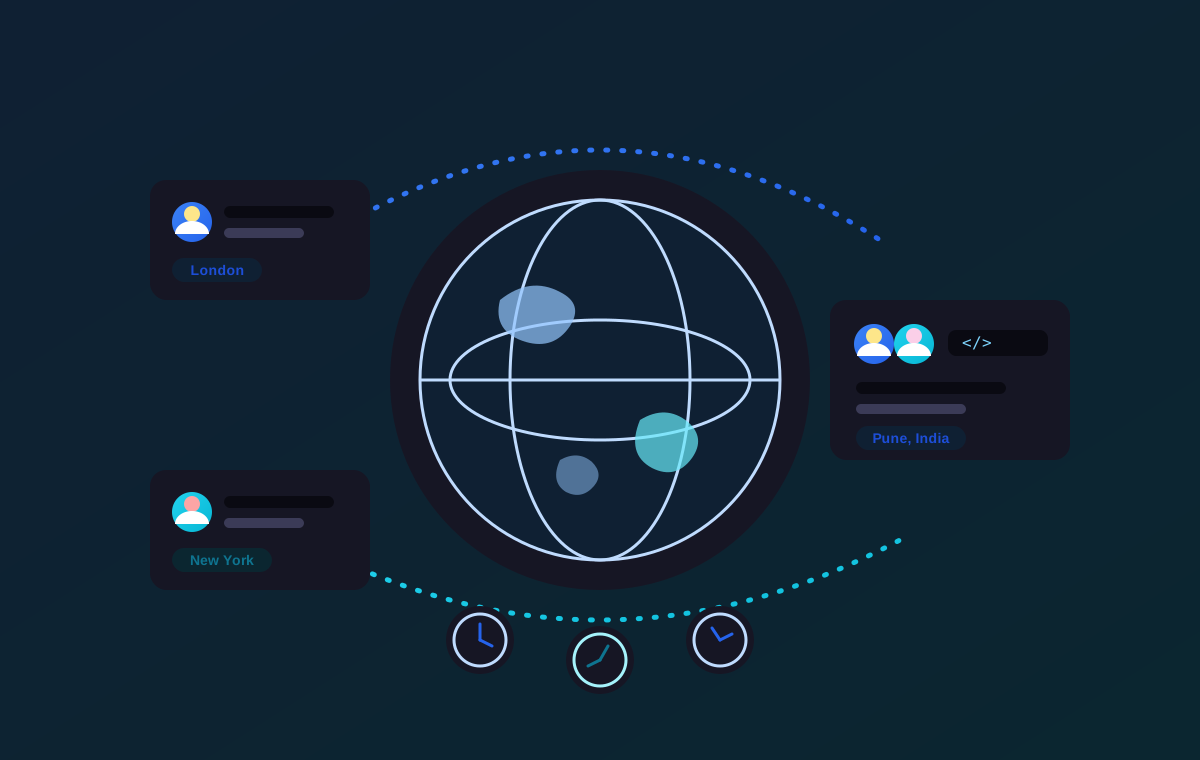
India runs at UTC+5:30 — but the number that matters is not the time difference, it is how much of your working day the team actually shares. A team working standard Indian hours overlaps far less than one that shifts its day to suit clients.
The figures below assume a shifted working day of roughly 12:30pm–10:30pm IST, which is what we run and what any serious offshore partner should be willing to do:
| Your location | Overlap with a shifted India team | How to run it |
|---|---|---|
| UAE / Gulf | ~7 hours | Effectively a shared working day |
| UK / Ireland | ~8 hours | A full shared day; call whenever suits you |
| Europe (CET) | ~8 hours | A full shared day; call whenever suits you |
| US East Coast | ~4 hours | Your morning is their evening; call 9am–1pm ET |
| US West Coast | ~2 hours | Early-morning call plus disciplined async updates |
| Australia (AEST) | ~5 hours | Your afternoon, their late morning |
Ask about this before you sign anything. A partner who will only work 10am–7pm IST is offering a UK client about half the overlap, and a US client almost none.
The gap can work for you. Send feedback at the end of your day and it is actioned overnight; you wake to progress. Teams that master this get something close to continuous delivery. Teams that do not end up waiting a full day for every clarification.
Two habits make the difference:
- Front-load questions. Send everything you know they will need before their day starts.
- Write things down, always. Verbal agreements across time zones and accents get misremembered. A short written summary after every call takes two minutes and prevents weeks of drift.
What good looks like week to week
By week two of a healthy project you should have:
- A written scope you both agreed to
- A shared board showing what is in progress
- At least one call already held
- Designs or a first working screen to react to
By week four:
- Something you can click and use
- A predictable update rhythm
- At least one instance of the team pushing back or proposing a better approach
That last one matters more than founders expect. A partner who occasionally tells you no is a partner who is thinking.
Warning signs — and what to do
| Warning sign | What it usually means | Act by |
|---|---|---|
| No demo in two weeks | Work is stuck or unstarted | Ask for a live walkthrough of whatever exists today |
| Vague updates ("working on backend") | Nothing concrete to show | Request specifics: which screens, what is blocked |
| Questions dry up | Assumptions being made silently | Prompt a scope review call |
| Requests for more money before a milestone | Scope or estimation problem | Pause; renegotiate scope in writing |
| Reluctance to give repository access | Possible lock-in | Insist on access now — it is your code |
Acting on these in week three costs a conversation. Acting in month three costs the project.
Your side of the bargain
Offshore teams are often blamed for problems that originate with the client. To get a good outcome:
- Be available. Book the call and keep it.
- Give decisive feedback. "I don't like it" is not actionable; "the booking button is hard to find on mobile" is.
- Protect the scope. Keep a "phase two" list and defend it.
- Provide content early. Text, images, and product data delay more launches than code does.
- Assume good faith, verify with demos. Trust built on visible progress is stable.
The bottom line
Offshore development works — reliably — when the engagement is run with written scope, fixed price, regular demos, fast feedback, and a partner willing to disagree with you. It fails when any of those are missing, and the cost saving is never worth a failed project.
The good news is that most of these levers are in your hands, and none of them are complicated.
Considering an offshore team? Tell us about your project — we work with clients in the US, UK, UAE and Europe on fixed-price scopes with weekly demos, NDAs, and full IP transfer, and we are happy to start with a small paid pilot so you can evaluate how we work. You can also compare costs by region or read our full guide to hiring in India.
Frequently asked questions
What is the most common reason offshore projects fail?+
Unclear requirements and slow feedback — not technical ability. When scope is vague, distance amplifies the gap between what you meant and what was built. Written scope, weekly demos, and fast feedback fix the large majority of offshore problems.
How do time zones work with an Indian development team?+
India is UTC+5:30, and a team willing to shift its working day gets far more overlap than the raw time difference suggests. Working roughly 12:30pm–10:30pm IST gives around 8 hours of shared working time with the UK and Europe, about 4 hours with the US East Coast, and a near-complete shared day with the UAE and the wider Gulf. Most teams schedule one call inside that window and work asynchronously otherwise.
How often should I get updates from an offshore team?+
A written update at least twice a week and a working demo every one to two weeks. If a fortnight passes with no demonstrable progress you can click through, treat that as a warning sign rather than normal.
How do I protect my intellectual property?+
Sign an NDA before sharing details, and make sure your contract includes an explicit IP assignment clause transferring all code, designs, and assets to you. Keep repositories, domains, and hosting in accounts you own from day one.
Should I pay upfront for offshore development?+
No. Use milestone-based payments tied to demonstrable deliverables, typically with a modest deposit to start. This protects both sides and keeps the project honest.
Have a project in mind?
Tell us what you need and we'll send a clear, fixed-price quote — usually within one business day.