"How long will my app take?" is usually the second question a founder asks, right after cost. The honest answer — it depends — is unhelpful, so here is a genuinely useful version: realistic ranges by app type, where the time actually goes, and what you can control.
Realistic timelines
These assume a competent team working steadily, with reasonably prompt decisions from you.
| App type | Timeline | Examples |
|---|---|---|
| Simple app / MVP | 4–8 weeks | Single-purpose tool, catalogue, basic booking |
| Standard business app | 2–4 months | Logins, backend, payments, notifications |
| Complex app | 4–8 months | Multiple roles, real-time features, integrations |
| Large platform | 8+ months | Marketplaces, fintech, heavy compliance |
Add roughly 1–2 weeks for app store review and launch preparation, and note that Apple's review is stricter and slower than Google's.
Where the time actually goes
For a typical three-month business app, the split looks roughly like this.
| Stage | Share of time | What happens |
|---|---|---|
| Discovery and planning | 10% | Requirements, user flows, technical decisions |
| UI/UX design | 15–20% | Wireframes, visual design, your sign-off |
| Frontend development | 30% | Building screens and interactions |
| Backend and APIs | 25% | Database, server logic, integrations |
| Testing and fixes | 15% | Devices, edge cases, performance |
| Launch | 5% | Store listings, submission, review |
Two things surprise people here. First, development is only about half the project — design, testing, and launch are real work. Second, testing is not optional padding. Skipping it simply moves the bugs to your users, who are far less forgiving than a test plan.
What makes the timeline longer
Number of features. The most direct factor. Every screen needs design, build, and testing. Ruthless scope control is the most effective schedule lever you have.
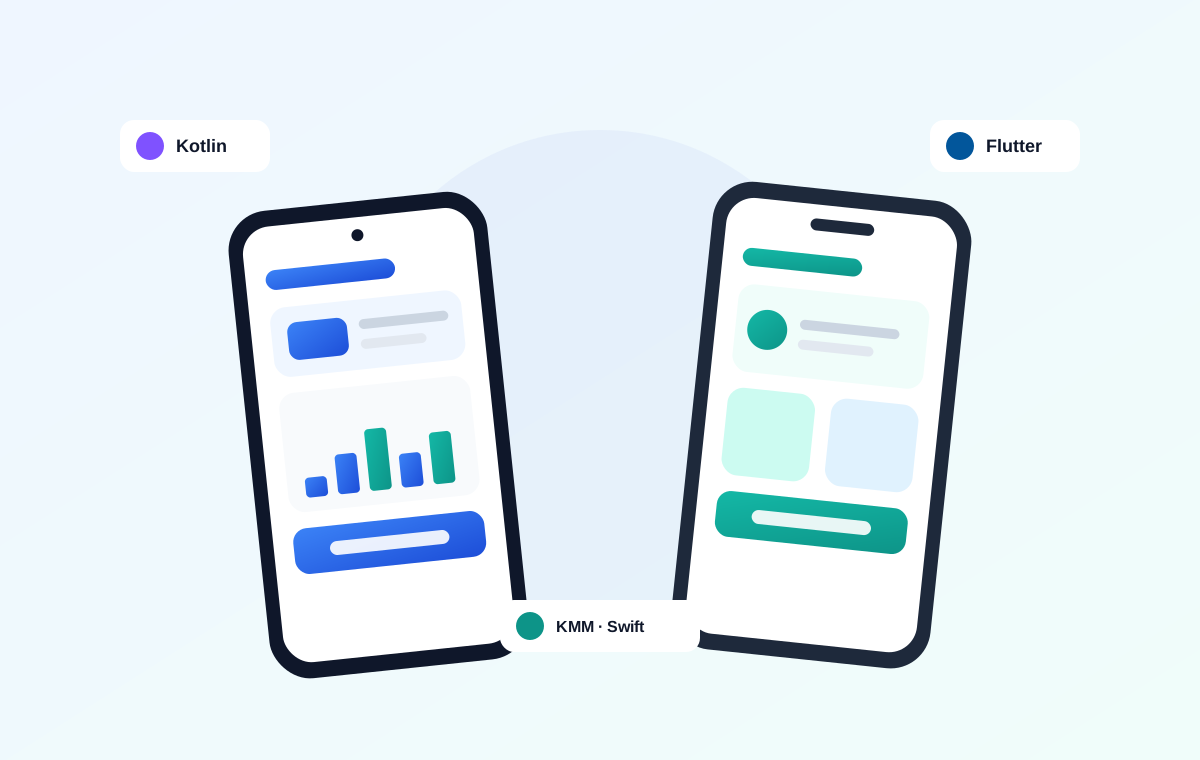
One platform or two. Native development for both Android and iOS roughly doubles frontend work. Cross-platform tools like Flutter or Kotlin Multiplatform build both from largely one codebase — often the difference between two months and three. See native vs Flutter vs KMP.
Backend complexity. An app that only displays content is quick. One with accounts, permissions, payments, and real-time sync needs a properly designed backend.
Third-party integrations. Payment gateways, maps, WhatsApp, CRMs, ERPs. Each one adds integration and testing time, and legacy systems with poor documentation can add weeks on their own.
Design maturity. Existing brand guidelines speed things up. Starting from a blank page — logo, colours, typography — adds time before development can begin.
Compliance. Fintech, healthcare, and anything handling sensitive data carries additional security and audit work that cannot be rushed.
What actually causes delays (and it is rarely the code)
In our experience, projects slip for predictable, avoidable reasons:
- Slow feedback. A design waiting five days for approval is five days lost. This is the single most common cause of overrun.
- Scope creep. "Can we also add…" mid-build. Every addition has a cost in time, even small ones.
- Missing content. Text, images, product data, and legal pages are needed before launch. Prepare them during development, not after.
- Late account setup. Apple Developer and Google Play accounts, payment gateway approval, and business verification can each take days or weeks. Start them in week one.
- Changing direction. Redesigning a core flow halfway through discards completed work.
You control four of these five. That is genuinely good news.
How to launch faster without cutting quality
Start with an MVP. Build the smallest version that delivers real value, launch it, and grow from real usage. A focused app in six weeks teaches you more than a comprehensive one in six months — and costs far less to correct.
Cut features, not quality. Fewer screens built properly beats many screens built carelessly. Removing a feature is free; fixing a rushed one is not.
Use cross-platform where it fits. For most business apps, Flutter delivers both platforms in close to the time of one.
Prepare content and accounts early. Have your copy, images, privacy policy, and developer accounts ready before you need them.
Decide quickly. Agree a feedback turnaround — 24 to 48 hours — and stick to it. This alone can save weeks.
Ship in phases. Launch on one platform first if budget or time is tight. Android reaches more users in India; iOS often reaches higher-spending ones.
What a realistic three-month plan looks like
| Weeks | Focus | Your involvement |
|---|---|---|
| 1–2 | Requirements, flows, technical planning | High — answer questions, agree scope |
| 3–4 | UI/UX design and sign-off | High — review and approve promptly |
| 5–9 | Core development, weekly demos | Medium — feedback each week |
| 10–11 | Integrations and testing | Medium — test it yourself |
| 12 | Store submission and launch | Low — final approvals |
Notice how much you are needed in the first month. Projects that start slowly rarely finish quickly.
The bottom line
Most small business and startup apps launch in one to four months, depending on scope and platform strategy. Anyone promising a complex app in two weeks is either misunderstanding your requirements or planning to cut something you will miss later.
The most reliable way to get a real answer is to describe what the app must do and get a scoped estimate with milestones.
Tell us about your app and we will give you a realistic timeline and a fixed-price quote — usually within one business day. You can also explore our mobile app development service or check whether an app is even what you need.
Frequently asked questions
How long does it take to build a mobile app?+
A simple app or MVP typically takes 4–8 weeks, a standard business app with logins and payments 2–4 months, and a complex app 4–8 months. Add 1–2 weeks for app store submission and review, which is stricter and slower on iOS.
Can an app be built in two weeks?+
Only a very simple prototype. Anyone promising a complete, production-ready app with logins, a backend, and payments in two weeks is either misunderstanding the requirements or planning to skip design and testing.
Does building for both Android and iOS double the time?+
With native development, frontend work roughly doubles. Cross-platform frameworks such as Flutter or Kotlin Multiplatform build both from largely one codebase, which often reduces total time by 30–40%.
What causes app projects to run late?+
Rarely the code. The usual causes are slow feedback on designs, scope added mid-build, missing content, and late setup of Apple Developer, Google Play, or payment gateway accounts. Most of these are within the client's control.
How much of my time will the project need?+
Most in the first month — answering questions, agreeing scope, and approving designs. After that, expect weekly demo reviews. Agreeing a 24–48 hour feedback turnaround is one of the most effective ways to keep a project on schedule.
Have a project in mind?
Tell us what you need and we'll send a clear, fixed-price quote — usually within one business day.